Login / Register
Guest
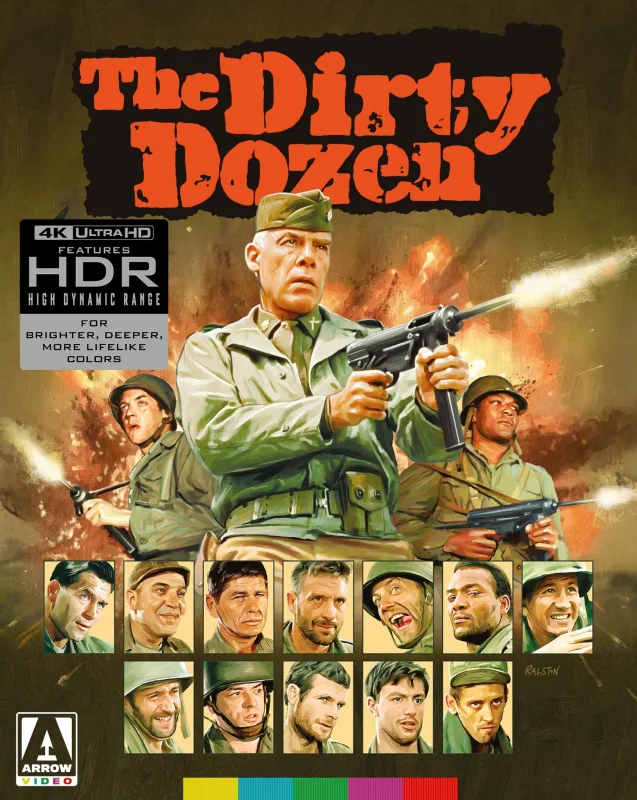
Codec: HEVC / H.265 (74.4 Mb/s)
Resolution: Native 4K (2160p)
HDR: Dolby Vision, HDR10
Original aspect ratio: 1.85:1
#English: DTS-HD Master Audio 6.0
#English: FLAC 1.0
#English: DTS-HD Master Audio 5.1
#English: Dolby Digital 2.0 (Commentary by film scholars Alain Silver and James Ursini)
#English: Dolby Digital 2.0 (Commentary by actors Jim Brown, Trini Lopez, Stuart Cooper, and Colin Maitland, producer Kenneth Hyman, novelist E.M. Nathanson, film historian David J. Schow, and veteran military advisor Capt. Dale Dye)
My first impression after watching “The Dirty Dozen” made me want to praise it to the skies, but then I stopped to think… I won’t repeat what the “previous speakers” have said—they’ve already hit the nail on the head. I’ll just add this from my own perspective.
In general, this American film is somewhat reminiscent of a roller coaster: one moment it’s a thrilling ride downhill with shrieks of delight, the next it’s a grueling climb toward a new dramatic peak. The filmmakers’ shifts from one genre to another are far from always logically justified: one moment it’s pure drama (the selection process for the unit in prison), the next it’s pure farce in the spirit of French films about “The Madmen” (see “ The Recruits Go to War’) in the episode where the command post is seized during exercises, then tragedy (when everyone started dying). So the film can by no means be called coherent. There are also predictable elements, but some are downright Chekhovian: the “gun” in the form of a female maniac eventually went off—literally...
But here’s something no one seemed to notice for some reason: along with the Nazi staff officers and generals, the valiant American commandos blew up nearly as many “civilians”—women (mistresses and simply prostitutes). Of course, anything can happen in war, and there was no other way to carry out the mission. But none of the film’s heroes uttered a single word about the innocents who were killed. What, did they deserve it? What, were German prostitutes worse than their own (the ones brought to the camp for these soldiers)? Here is yet another manifestation of bourgeois American cynicism, with which the descendants of this dozen burned villages in Vietnam and reduced residential neighborhoods in Iraq and Libya to dust. Is this not fascism?
In every other respect, the film deserves to be called a classic, albeit with its flaws.
 Telegram and be the first to know about updates!
 [/xfnotgiven_poster]
 [/xfnotgiven_poster]